Back-to-Schooling September: Questions from Guests!
Thank you for submitting your curiosity questions during Back-to-Schooling September. Here are answers to some of the questions that we did not yet answer on social media.
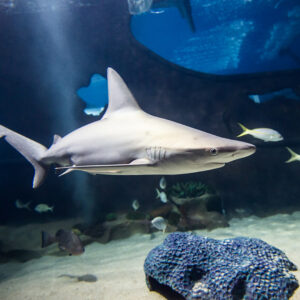
How do sharks sleep?
Sharks do not sleep like humans do, but they do have restful and active periods. Because many sharks must swim constantly to breathe, they only rest half of their brain at a time; the other half stays awake to maintain basic functions like swimming. They also don’t have eyelids to close, so their eyes stay open while resting.
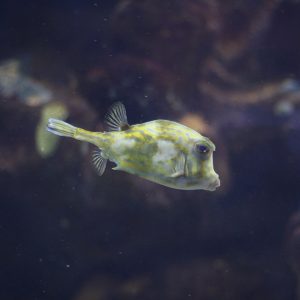
Do fish fart?
Fish can release gas for a variety of reasons, but it’s not usually due to digestion. Many fish have swim bladders to control their buoyancy in the water; they release gas to adjust their position in the water. Some fish release gas to communicate to one another in schools. Fish that lack swim bladders, like sharks, typically do not fart.

How many tentacles do jellyfish have?
Jellies (they’re invertebrates, not fish) have a wide range of species and therefore a wide range of tentacles. Moon jellies, like you can see at the Aquarium, typically have 8 tentacles with stinging cells for trapping food and 4 frilly oral arms that help clean the body and direct food to the mouth. Other species like lion’s mane jellies can have hundreds of tentacles, and the tentacles on a Portuguese man o’ war jelly can be more than 30 feet long!

Will you get a hammerhead shark?
A top priority of the Aquarium is animal wellbeing. Habitats at the Aquarium must provide the needs of animals to not only survive but thrive. Hammerhead sharks have needs that cannot be met well in an Aquarium setting. Their large size (13 feet long) and constant movement would require a huge open space, larger than the Aquarium can accommodate in a historic building. Hammerheads are also highly sensitive to changes in water quality, light and noise, which could cause significant stress in an Aquarium setting. And, hammerhead sharks are a highly social species, spending time in large schools. In order to properly care for a hammerhead, you’d need a whole group of other hammerheads too.

Why is the water for the stingrays deep?
The stingrays in the touchpool have choice and control over their environment. If they are curious and want to come to the surface within touching range, they can. If they want a break or a rest, they can swim deeper in the water to avoid interaction. The deeper pool helps ensure healthy stingray wellbeing.
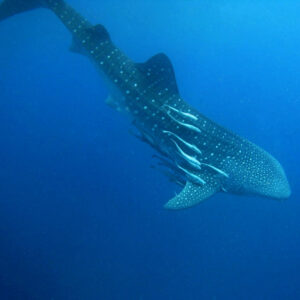
What is the difference between a whale and a whale shark?
Whales are mammals. They have hair, are warm-blooded and produce milk to feed their young. Whale sharks are fish. They are covered in dermal denticle scales, are cold-blooded and their young are on their own from birth.

Do the fish eat each other? Do the sharks eat the fish?
Careful consideration goes into planning what types of fish can live together at the Aquarium and into the design of the habitats themselves. The animal care team also puts a ton of energy into ensuring each animal is provided a healthy diet to ensure its wellbeing. Plan to visit the Aquarium during our next shark, gamefish or Amazon River habitat feed to learn more about the specifics.
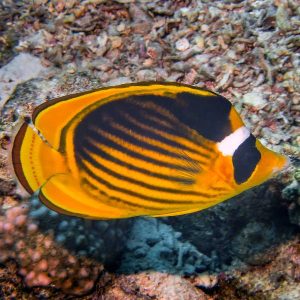
Why do fish swim so fast?
Fish are well adapted to their specific habitats and not all fish swim fast. Fish that live in open water often have forked or crescent shaped tails to swim fast to avoid predators. Other fish, like coral reef dwellers have rounded or wedge-shaped tails to swim slowly through the rocks and corals on the reef.
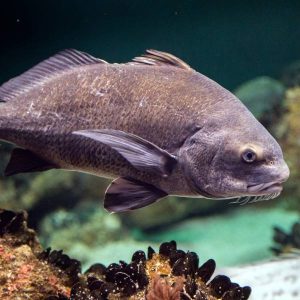
How do fish breathe?
As humans, we use lungs to breathe oxygen from the air around us. Fish use gills to breathe oxygen from the water. Some fish have an organ to pump water through their gills while resting, most sharks swim constantly to pass water through their gills, and moray eels gulp water through their mouth to pass over their gills.
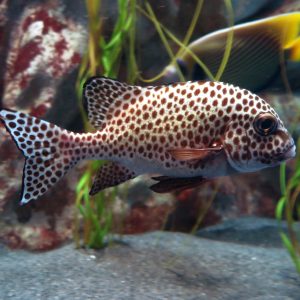
What happens to the fish poo?
Keeping habitats clean is a lot of work and requires a team effort. The life support systems (LSS) team at the Aquarium manages the pumps and filters on each habitat that work to filter out waste. There are also helpful bacteria in the water that break down the waste, and the LSS team routinely does water changes to control the ammonia levels in the water that can build up from fish waste. Additionally, the animal care team spends time scrubbing the walls and vacuuming the sand or gravel in the habitats to remove algae and waste. The dive team does this in the larger habitats like shark, stingray touchpool, coral reef, and others.
Is your curiosity still burning? Check to the Aquarium’s YouTube channel to learn more about the Aquarium and aquatic life.