
School Field Trips
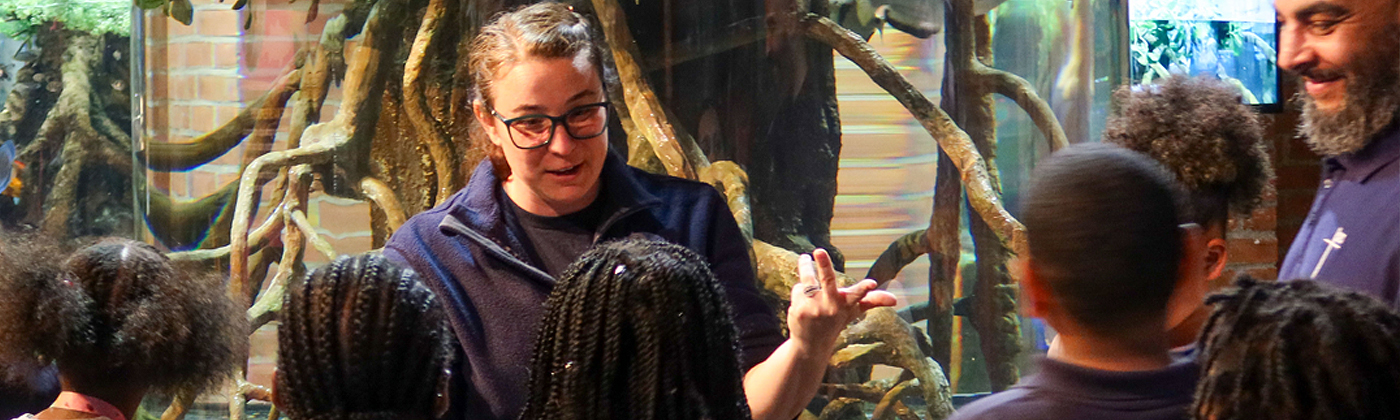
In-Person Class Learning
Program
- Every program includes interactive materials to encourage inquiry-based learning
- Most programs run 75-90 minutes in length
Group Size
- Max of 75 people total for all programs, including adult staff/chaperones
- 15–30 people will split into 2 tour groups, 30-45 people will split into 3 tour groups, 45-60 people will split into 4 groups, and 60-75 people will split into 5 tour groups
Cost & Payment
$11 per student, plus tax
- School staff chaperones are free
- Additional adult chaperones are $11, plus tax
- Final headcount and cost are calculated the day of the trip; a quote is provided upon booking. Walk-in groups will be charged general admission rates and allowed entry pending Aquarium capacity.
- Credit card, check, cash, and invoice/purchase order options are accepted
Please Note: These rates are only available for guided field trips scheduled in advance. Walk-in groups will be charged general admission rates
Scheduling
- Now booking 2026-2027 school year
- Available Monday-Friday 10am-4pm; first come, first served
- Your trip is officially booked when you receive a reservation confirmation sheet from the Aquarium team
How to Book
To book a program, please fill out a request form.
Questions
Email: education@greaterclevelandaquarium.com
Phone: 216.862.8803 x 7718
Available Programs
All programs below are fully guided unless noted, but all have a self-guided option. Let us know upon booking if you prefer a self-guided experience for your group, and the Aquarium will provide inquiry-based materials for that specific program upon arrival
Aquatic Trek
[All Ages]
Do you have a mix of age ranges in your group or just cannot decide on one topic? Explore the wonders of biodiversity at Greater Cleveland Aquarium in this general guided tour. Venture through each of the Aquarium galleries, meet hundreds of animals from a variety of ecosystems and ask Aquarium educators questions along the way. Engaging scavenger hunts are available if your group has a specific topic request.
Shapes and Colors
[Preschool – Kindergarten]
The world around us consists of all kinds of shapes and colors to sort and classify. With many animals that look very different from one another, the same is true at the Aquarium. Get a sense of the wide variety of appearances these creatures have. We will look for familiar shapes and colors while taking a close look at a variety of aquatic animals.
Finding Fish Friends
[Preschool – Kindergarten]
[Self Guided]*
During an interactive reading of Fitz the Fish Finds His Friends by Dakotah Pike, students become familiar with a variety of ocean creatures. Meet Fitz the yellow tang, Olivia the octopus and other aquatic pals to discover what makes each animal unique. In the Aquarium while looking for Fitz and his friends, students will explore colors, use observation skills and practice counting. (*15-20 minute guided story time, 60 minute self-guided tour)
Reptiles, Amphibians, and Fish, Oh My!
[Kindergarten – Grade 2]
[Self-Guided]*
During an engaging reading of Don’t Trust Fish by Neil Sharpson, students will become familiar with different types of animals. We will explore major animal groups including reptiles, amphibians, mammals, birds, invertebrates and fish. We will learn what unique traits are used to sort animals into each group. In the Aquarium, students will use their knowledge to sort animals when they meet turtles, frogs, sharks and more! (*15-20 minute guided story time, 60 minute self-guided tour)
I See Sea Creatures
[Preschool – Kindergarten]
After participating in an interactive reading of the Eric Carle tale A House for Hermit Crab, an Aquarium tour reveals the real-life animals that inspired Carle’s characters. Students join Aquarium educators on a search for the saltwater stars of the story along with some new freshwater friends. Discover shapes, colors and patterns of aquatic animals, and practice counting along the way.
Habitat Exploration
[Kindergarten – Grade 2]
Can a sandtiger shark live in Ohio? Can a channel catfish be found in the Atlantic Ocean? Explore the elements of a healthy habitat on this Aquarium adventure. Investigate both freshwater and saltwater environments, answer questions to build pond and ocean habitats, and discover how each unique habitat provides its animal residents with everything they need to survive.
CSI
[Kindergarten – Grade 2]
Investigate how living things have adaptations to help them get oxygen, find food, use water and seek shelter. Which animals breathe with lungs and which breathe with gills? Is there a fish that actually spits water to hunt? Who has the most impressive camouflage? Observe hundreds of amazing animal adaptations on your adventure through the Aquarium.
Food Web Adventures
[Grades 3 – 5]
Food Web Adventures takes young explorers on a journey from sunlight to supper, unraveling the intricate connections that sustain life in biodiverse habitats. Through an inquiry-based guided tour and game, participants dive into fishy feasts and discover how energy flows from plankton to predators in aquatic ecosystems. Find out who eats whom and how!
Aquatic Animal Adaptations
[Grades 3 – 5]
Investigate how different habitats support animal life and identify unique adaptations that allow living things to thrive in these distinct places. Through an inquiry-based guided tour and game, compete with your classmates to answer trivia questions along the way. There are so many different adaptations among the aquatic animals, observations and discoveries are endless.
Ecosystem Challenge
[Grades 6 – 8]
Explore how ecosystems function and change through an interactive, team-based challenge. Students will learn how ecosystems stay in balance and how they shift over time, from predator-prey relationships to human impacts. During an interactive guided tour, students will make choices to help their ecosystem survive or thrive to help deepen their understanding of the natural world. This engaging program encourages collaboration, curiosity, and critical thinking.
Blue Planet, Green Future: Global & Local Conservation
[Grades 6 – 8]
Conservation is an ongoing journey, and every generation has a role to play in shaping its future. Explore the history of conservation in Ohio through an interactive timeline activity. On the guided Aquarium tour, students investigate topics including invasive species, endangered animals, biodiversity, habitat loss and the role of aquariums in conservation. Along the way, students connect local conservation stories to global challenges and discover how individual and collective actions can help create a healthier future for our planet.
Careers & Conservation
[High School]
As interests develop and career ambitions start to form, exposure to STEM careers can be a key step in a student’s academic journey. As we explore the Aquarium through an interactive guided tour, we highlight STEM careers at our facility, the diversity of jobs it takes to run an Aquarium and how conservation passion can lead to a career path. We also tackle challenging and thought-provoking questions about conservation-related themes.
Custom Programming
We welcome program ideas from teachers! Contact us at education@greaterclevelandaquarium.com with suggestions.
Aquarium Field Trip FAQs and Additional Information
How far in advance do you recommend booking?
-Our program calendar fills on a first-come, first-served basis. We recommend at least two weeks in advance during slower times of the year, such as September and October. For February through May, we recommend reaching out during the prior Fall to book your preferred date and time for your group.
Can we reschedule our program?
-Rescheduling is subject to availability. We will do our best to accommodate you. If you need to reschedule, please reach out as soon as possible.
Can adult chaperones pay individually?
–To receive the discounted education rate of $11 plus tax, adult chaperones must be included in the single group payment. Adults paying separately from the group will be charged the regular admission rate of $19.95 plus tax. Anybody paying separately would still be included in the maximum group size (75 total people for guided programming).
Does an exemption from the State sales tax apply to the City of Cleveland admission tax?
-No. Although Ohio offers various exemptions from State sales tax, these exemptions do not extend to the City of Cleveland admission tax.
Where do we go when we arrive?
-The group leader should check in with an Education team member in the Powerhouse lobby. Please have your final headcount of students and chaperones and be ready to provide payment. Final cost will be calculated on the day of the visit.
When should we arrive once we have our program start time?
-If possible, it’s best to arrive around 10 minutes before your designated program start time. This allows ample time for checking your group in, potentially dropping off coats and lunches, having a restroom break, etc.
Where can buses park?
-Bus parking is free. Buses can drop off groups at the front door of the Powerhouse before parking in the rear of the parking lot. Drivers should bring in their parking slips for validation. Bus drivers receive complimentary admission.
Are we able to self-guide through the Aquarium?
-Yes, groups are welcome to go back through the Aquarium and self-guide after programs. While self-guiding through the Aquarium, please make smaller chaperoned groups of 10 or fewer people. For a fully self-guided visit without an education program, view group sales options here.
Can we arrive before the program time to self-guide?
-No, the guided program is always the start of a group visit.
Do you offer lunch space?
-Yes, there are multiple shared indoor lunch spaces, with limited seating and subject to availability. Lunch space can be requested during the booking process. Lunches can be stored in these areas during your visit, but we do not recommend leaving valuable items in these shared spaces. Tables and chairs are reserved using your estimated headcount. If this number changes, please let us know ahead of time as soon as possible.
Outdoor picnic-style areas are available on a first-come, first-served basis, weather permitting. The Aquarium does not provide storage space for groups eating outside, and lunches should be left on the bus.
Are there any food options available on-site?
-The Aquarium does not have full-meal lunch options on-site. There are snack and candy items available for purchase in the Gift Shop and in vending machines.
Are we able to visit the Gift Shop?
-Students are welcome to visit the Gift Shop after the educational program. While in the Gift Shop, students must be chaperoned in groups of 10 or fewer. Please let us know during booking if your students will have money to shop so we can staff the store appropriately and allow time after the guided program.
Do you have a space to store coats and backpacks?
-Coats and backpacks may be left in the shared program spaces. We recommend that valuable items remain with guests during the program. To help reduce the number of lost-and-found items, coats and backpacks could be left on the bus or in the car if possible. The Aquarium is not responsible for lost or stolen items.
Is the Aquarium accessible?
-The Aquarium is wheelchair accessible and is located on the lower floor of the building. A single wheelchair capacity lift is available to navigate from the lobby entrance to the Aquarium.
If your group has 5 or more guests using wheelchairs, please let us know at booking. A larger capacity elevator is available in a different area of the building.
If you are booking a group visit that supports individuals with disabilities or other accessibility needs and would prefer a self-guided visit, please click here for more information.
Student Expectations
Be safe:
-Stay with your chaperone, walk inside, and follow adult instructions.
Respect people:
-Please be patient and kind, take turns to view animals and use step stools, use indoor voices, and keep hands to yourself.
Respect animals:
-Please do not tap animal habitat windows, follow instructions at touchpools, and turn off flash when taking photos.
Have fun!
Chaperone Expectations
A ratio of 1 chaperone for every 10 students is required.
Student safety:
-Stay with your students, take frequent headcounts, and notify staff in case of an emergency.
Student behavior:
-Help with student expectations, and be engaged in programming.
Thank you!
Funding provided by our partners: