Press ENTER to search, ESC to clear

5 Things I Learned About Banggai Cardinalfish

New to the Aquarium, little by little I am learning about aquatic life. This week the Banggai cardinalfish caught my eye. Apparently this little looker has caught many people’s attention because the live marine ornamental trade demand has its numbers dwindling. Conservatively 500,000 are being scooped up in the wild annually—more than half of which don’t even survive long enough to make it to a pet store. A 2015 survey estimated only 1.4 million fish were left in its small, natural range in Indonesia’s Banggai Islands.
Here are five things I’ve learned about the coveted species that the US National Marine Fisheries listed as “threatened” under the Endangered Species Act last year:

You can learn more about the Banggai cardinalfish at the Greater Cleveland Aquarium—where curiosity is only natural.

— Sam Fryberger, Marketing Director

5 Things I Learned About Shovelnose Sturgeon

When I joined the Greater Cleveland Aquarium team, I realized I hadn’t even skimmed the surface when it came to understanding aquatic life. Now I am diving into learning about a different animal each week.

This time my lesson focuses on the shovelnose sturgeon, an animal that embodies that phrase “age before beauty.” According to the U.S. Fish & Wildlife Service, sturgeons pre-date many fish species—“appearing in the fossil record approximately 200 million years ago.” Here’s what I have learned about the prehistoric creature:


If you’d like to see a shovelnose up close, visit us anytime at the Greater Cleveland Aquarium—where curiosity is only natural.

5 Things I Learned About Lionfish

When I joined the Aquarium marketing team, I realized exactly how much I didn’t know about sea creatures. That’s why I plan to dive into learning aquatic life by spending time in the exhibits and talking to our aquarists. Lesson 1? Lionfish. Here are five things I’ve discovered about this beautifully banded fish with a voracious appetite.

In the last week, researchers have released a recording of lionfish that sounds a little like a drumbeat. Want to hear it? Click here.

And of course, if you want to see the lionfish in the video from 360-degree views, visit us anytime at the Greater Cleveland Aquarium in the First Energy Powerhouse on the West Bank of the Flats.

Celebrating World Turtle Day

IMG_4497African Sideneck Turtle

The African Sideneck Turtle is a freshwater turtle, originally discovered in Eastern and Southern Africa, with a lifespan of 25+ years. These turtles are most active during the day and in the wild they spend most of their time in the mud of shallow lakes and rivers. African Sidenecks mainly consume invertebrates such as: insects (crickets), mealworms, and worms. They got their name due to the fact that they cannot fully withdraw their head into their shell. Instead, the head is turned to the side and folded under the upper edge of the shell.

podocnemis-unifilis-a122_p3_0Yellow-Spotted Amazon River Turtle

Similar to the African Sideneck, the Yellow-Spotted Amazon River Turtle cannot fully withdraw its head into its shell. These turtles are native to the Amazon River basin and can be found in the amazon and Orinoco river systems in Venezuela, eastern Colombia, eastern Ecuador, northeastern Peru, the Guianas, Brazil, and northern Bolivia. They are omnivorous and feed on both vegetation and small animals. And they love to spend time basking along the riverbanks and in the calm waters of big rivers and streams. The oldest known Yellow-Spotted Amazon River Turtle living in human care reached 23 years of age, but they can live up to 70 years!


IMG_9058Ohio Spotted Turtle

The Ohio Spotted Turtle is a small (less than six inches) black turtle with distinctive yellow spots on the top of the shell, or carapace. The Spotted Turtle populations have declined greatly throughout Ohio due to people altering wetlands and thereby destroying its natural habitat. These turtles have a preference for the shallow, sluggish waters of ditches, small streams, marshes, bogs, and pond edges – especially where vegetation is abundant. They feed on plant and animal matter taken underwater. If this turtle is disturbed it may quickly dive for safety, or it may leisurely walk into the water and swim to the bottom where it may remain motionless, burrow into the muck, or crawl beneath some sheltering object such as a submerged log.

IMG_4477

The Spotted Turtle Project

Member organizations of the Lake Erie Allegheny Partnership for Biodiversity (LEAP) are dedicated to the protection and restoration of biological diversity in our region. LEAP members have formed the Save and Protect Ohio Turtle Diversity (SPOTD) committee. The goals of this committee are to:

  • Increase survivorship of turtle hatchlings
  • Repatriate populations of this Ohio Threatened species in protected habitats within Northeast Ohio
  • Increase recruitment of these animals into the adult populations
  • Educate the public and involve local academics through research

There are many threats today that have a great impact on Spotted Turtle populations, such as:

  • Wetland Loss/Degradation
  • Habitat Fragmentation
  • Illegal Harvest/Pet Trade
  • Roadway Mortality
  • Climate Change
  • Human-caused increases in Meso-Predator Populations (i.e. Raccoon)
  • Delayed Sexual Maturity
  • Low Reproductive Potential
  • Pollution

During the months of March-May, if you see this yellow spotted, black turtle anywhere in Northeast Ohio as you are hiking through trails and natural areas, let the SPOTD committee know by emailing SPOTD@leapbio.org.

For more information on this project visit Leap’s website.

O-fish-ally The Best Moms

Archerfish

The female lays about six to eight eggs in a very secluded group of trees. Usually, it can find a very safe hollow within the roots, visible only by careful observation. These eggs are undeveloped, and are only about half a nailsbreadth in width. There are usually many more female eggs than male eggs, about a two to one ratio.

As soon as the eggs are hatched, the male leaves and the females are left to take care of the newborns. This process sounds difficult, but because of the rapid rate at which they mature, only about a month to reach full size, the mother is actually not unduly challenged. They must be very carefully as to not aggravate a female by not checking to make sure the tissue between their anal fins is still intact. This is almost never a problem, but if it does happen the female will answer by fiercely by blowing water in the face of the male.

Giant Pacific Octopus

Giant Pacific Octopus has one successful brood in her lifetime. After mating, a female will lay up to 74,000 eggs or more in a deep den or cave and live there for seven months watching over them. During this time, dedicated mothers won’t venture out for food, and shortly after the young hatch, the mother will die.

Banggai Cardinal fish

The female spawns a mass of up to 75 large eggs (a very small number for a marine fish). These are quickly swallowed by the male, and brooded in a special pouch inside the mouth. A unique feature of these cardinal fish is their manner of mouth brooding reproduction. Typically cardinalfish incubate their eggs orally until they hatch, at which point the fry swim away and enter the water column. Females aggressively defend its territory by immediately chasing any intruders that approach the brooding male.

Stingrays

Young stingray pups hatch from eggs inside the female and are released from her body alive. Its reproduction period is June through October. Cownose rays typically produce one pup per pregnancy, though there have been reports of six concurrent embryos in a female.

Pharyngeal Jaws and Green Moray Eels

Did you know that there are animals at the Greater Cleveland Aquarium that have more than one jaw? Moray eels have been known to have a second jaw, or pharyngeal jaw. The aquarium is home to several moray eels, many of which you can find in the Shark Exhibit swimming right along with the sharks and other fish.

eel

Green moray eels are a pretty amazing animal, full of secrets. Just about ten years ago researchers discovered that these curious animals actually have a second jaw. This jaw, known as a pharyngeal jaw, is how they are able to eat. Most fish use suction to swallow. They expand their mouths to create negative pressure. This negative pressure causes water and prey to rush into their mouths allowing them to swallow their prey. Moray eels do not have this ability. Instead, they lie in wait in caves and crevices for their prey to swim by. They then burst out and grab their prey with their oral, or first set, of jaws. Their pharyngeal jaws then move forward to grip it. They can then move these jaws backwards to swallow their prey whole. They typically eat fish, shrimp, squid, crabs and octopus.

eel graphic

Another secret that green moray eels have is that they are actually brown! Their bodies are covered with thick yellow mucus that gives them their vibrant green color. This mucus protects the eels from parasites and infectious bacteria.

Green moray eels are found along the western Atlantic and into the Gulf of Mexico. They’re frequently found in the Bahamas and the Caribbean and been found as far south as Brazil. When full grown they can get to be 8 feet long and weigh as much as 65 pounds. Green moray eels have few natural predators once they reach full size, although smaller eels must look out for sharks and other large predators.

eel 2

Next time you are at the aquarium make sure you look for the green moray eels. They are nocturnal in nature so they tend to spend a lot of the day hiding in the rocky structures around the exhibit. You’ll see their heads and part of their bodies sticking out. However, we often see them swimming around throughout the day. They even like to visit the divers when we are in the exhibit. Also, be sure to visit the aquarium on a Sunday, Tuesday or Thursday at 3:30 to watch the shark feed! The eels are often seen coming over for a snack as well. Look fast! Maybe you’ll just catch that pharyngeal jaw in action!

Symbiotic Relationships

Symbiotic relationships occur all around us every day. They are quite simply relationships between two different species where at least one species benefits. There are three main types of symbiotic relationships:  mutualism, commensalism and parasitism. Let’s focus today on mutualism, or a relationship where both organisms benefit from each other. The Greater Cleveland Aquarium has multiple examples of this happy relationship!

Let’s start out by taking a journey into our live coral exhibit, because that happens to be the site of not one, but TWO mutualistic symbiotic relationship. Both involve (you guessed it) coral! The first one involves a very famous movie star that goes by the name of Nemo. Now most people associate the clown anemonefish with anemones, hence the name. However, in this particular exhibit, the anemonefish has a relationship with a type of coral known as Ricordea florida, which doesn’t actually have a common name. This coral protects the anemonefish with its stinging tentacles, which the anemonefish are immune to because of a protective mucous coating. In return, the anemonefish gives protection to the coral by being aggressive and fighting away other fish that might otherwise prey on the coral. Also, the coral can feed on bits of food from the anemonefish’s meal. Everyone wins.

work fish 553 Ricordea florida

Coral play a role in our Aquarium in multiple mutualistic symbiotic relationships. The next one we’ll look at is the connection between coral and zooxanthellae. Zooxanthellae, if you’ve never heard of them, are plant-like microscopic algae that live within the tissues of coral. The coral, once again, offer a protected home with their stinging tentacles. The zooxanthellae also receive the compounds necessary for photosynthesis from the coral, which is why coral need clear, low-turbulent waters to grow in, so the sunlight can reach them. Once photosynthesis is complete, the zooxanthellae transfer up to 90% of the products to the coral, which include oxygen and carbohydrates. The most fun and beneficial part for us humans is that the zooxanthellae provide the coral with the many different vibrant colors that are seen on coral reefs.

Zooxanthellae

Our next relationship takes place in our stingray touch pool where there’s an interaction between our stingrays and the cleaner wrasse. While a stingray is resting on the bottom, a cleaner wrasse will use that opportunity to swim up and start the process. The cleaner wrasse, as its name suggests, cleans the stingray of dead skin and parasites, essentially getting an easy meal. The stingrays stay clean while the wrasse stay full! In the wild, the stingrays would also be a form of protection for the wrasse but that isn’t an issue in our friendly touch pool. Be sure to look carefully for these cleaner wrasse. Not every guest notices them.

5D3_4337 Cleaner Wrasse

Our last symbiotic relationship covers one that pertains to us humans directly. One of the newer exhibits at the Greater Cleveland Aquarium is the invertebrate touch pool, which is home to many different invertebrates, including cleaner shrimp. In the wild, these shrimp would receive their food by removing external parasites and old skin from eels, groupers and other fish. Here at the Aquarium though, guests can walk up and place their fingers in the water for a free mini-manicure! The cleaner shrimp hop right on your fingers and start cleaning away. Now hopefully we don’t have any external parasites, but old skin we surely have – so that makes a great meal for the shrimp.

Cleaner Shrimp

Do you SEA the resemblance?

Do you SEA the resemblance?

The Greater Cleveland Aquarium is home to quite a variety of interesting aquatic life from all different parts of the world. With a touch of so many different places here, you’re bound to run into some pretty interesting looking little guys. Let’s call this one, celebrity doppelgangers for fish.

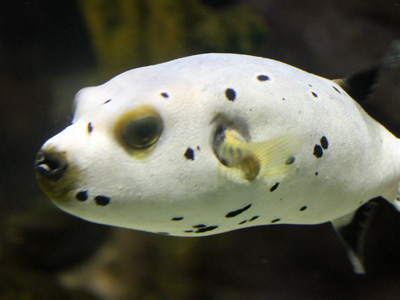
Dog-Face-Puffer

1. Dog Face Puffer – Dog

Imagine if a dog was stuck inside a fish body because that’s basically what makes up our friend, the Dog Face Puffer. He’s a native of the Pacific and calls our Indo-Pacific gallery his humble abode. The Dog Face Puffer gets its name from its appearance, and I bet you can guess why – he looks fairly similar to a canine! Oddly enough, Puffer fish have been known to have personalities similar to dogs. However, the Dog Face Puffer doesn’t have teeth like his furry friends, but instead has a fused beak-like structure, which it uses to crush its food.

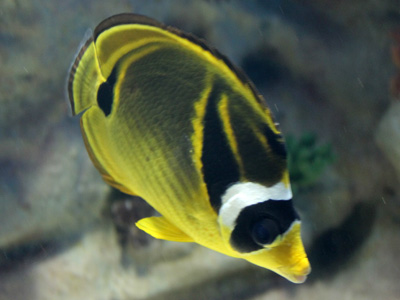
2. Raccoon Butterflyfish – Racoon

Sounds like a weird combination, right? However, the combination of the traits from these two very different animals actually creates a beautiful aquatic creature. This fish gets its name from its highly recognizable mask over its eyes, nearly identical to that of a raccoon. Its beautiful yellow coloring and shape resemble a butterfly. This remarkable combination makes for an awesome addition to the Tropical Reef of the GCA.

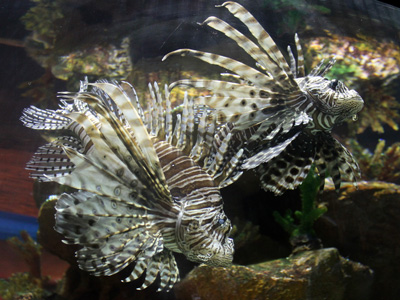
3. Pterois aka Lionfish – Lion

This fish is given its name due to its venomous fins that create a look similar to the mane of a lion. The Pterois is found mostly in the Indo-Pacific, and can be found there within the Greater Cleveland Aquarium. If attacked or threatened, the fish will deliver a potent venom through it’s needle-like dorsal fins. The sting from this act is extremely painful to humans, sometimes resulting in nausea or breathing difficulties, but is rarely fatal.

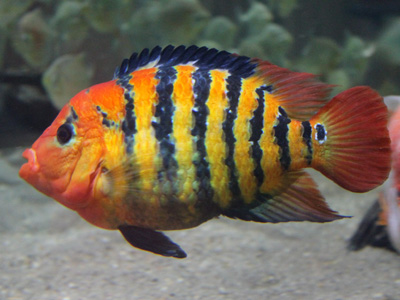
4. Red Terror Cichlid – Tigers

He’s got the eye of the tiger, and you’re gonna hear him roar! Well, maybe more like blow bubbles, but you get the point. The Red Terror Cichlid typically sports a beautiful orange color with black stripes – similar to a wild tiger. These fish tend to be territorial a similar characteristic of tigers. It can generally be found along the banks of rivers hiding under brush. You can visit our Red Terror Cichlid in our Lakes and Rivers of the World gallery.

Be sure to look out for these amazing aquatic creatures on your next visit to the aquarium! You never know what resemblances you might see!