Best Places to Dive: Ice Diving – Lake Charlevoix, Michigan
 Not every diver seeks tropical water and colorful fish. For some, the lure of historic shipwrecks or the challenge of cold-water diving draw them further north and inland to freshwater lakes. The Great Lakes is a wonderful location to find thousands of wrecks that, due to the lack of corrosive saltwater and stronger ocean currents, tend to be better preserved.
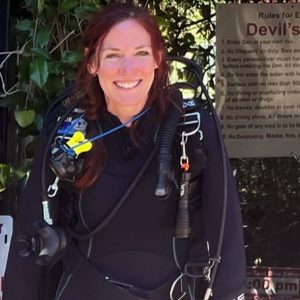
Robin Murray is one of the newest members of our dive team. Although she only joined Greater Cleveland Aquarium in January 2023, Robin has been diving since 2019 and has 185 dives under her weight belt. One of her most memorable dives is her ice dive at Lake Charlevoix (pronounced SHAR-le-voy) which can be found at the northern end of the southern peninsula of Michigan and connects to Lake Michigan via a narrow channel.
While not the preferred method of your average amateur diver, ice diving provides some wonderful advantages that weigh against its inherent challenges. Cold water tends to provide terrific visibility and, not surprisingly, fewer crowds than typically encountered at a tourist location. For those that live in colder climates, it can be the only opportunity to dive through the long winter months.
However, those diving under the ice must take extra precaution, as they are diving in an overhead environment which limits ability to go directly to the surface in an emergency. A scuba regulator can malfunction due to cold water. Regulators can freeze over and subsequently free-flow, resulting in all of the diver’s air rapidly being depleted. These malfunctions and hypothermia are the other main risks of cutting a hole through the ice and exploring below the surface.
For those like Robin who brave this environment, Lake Charlevoix offers a particularly notorious shipwreck to explore. The Keuka, a barge for hauling timber had plied the lakes since it was built in 1889. During Prohibition, its owners converted its hold to a roller rink and advertised outings as a party barge, but it was really a floating casino and speakeasy.
Local historians won’t confirm rumors that notorious gangster Al Capone had a hand in its operation, but there is no doubt that the Keuka offered entertainment that was decidedly “illicit” until it sank under suspicious circumstances in August of 1932, a year before the end of Prohibition.
The wreck is more than 200 feet long and lies 50 feet under water, but the top deck is only 15 feet under the surface due to the immense size of the vessel. The Keuka seems to be a stable vessel and is a favorite of divers and snorkelers alike due to its accessibility. In the bow of the wreck, a large bait ball of bass tends to congregate, delighting visitors to the ship’s interior.
So, whether you want to don your dry suit and cut a hole in the ice with a chainsaw or wait to go out on a summer charter, Lake Charlevoix and the surrounding waters provide a rich opportunity to explore history and adventure.
Lake Charlevoix is the sixth in our weekly series of the Aquarium dive team’s favorite dive locations. Stay tuned for the rest of our list or suggest somewhere new we might want to explore.
- Ray D.
 In 1999, a daring spearfisherman in Greece named Manolis Efthymakis made a stunning discovery. While free-diving 30 feet down, he saw an opening in the cliff wall and did what most of us would not: he swam into it. What he found drew the interest of both the diving and the archaeological community.
 Just eight degrees south of the equator and nearly 10,000 miles from Cleveland, the island of Bali is a province of Indonesia and lies within the Coral Triangle, an area of immense biodiversity between the Pacific and Indian Oceans.
 A shade over 66 million years ago, a six-mile-wide meteor came screaming out of the heavens at 12 miles per second and a 60-degree angle to the surface of the Earth, which is kind of a worst-case scenario angle in terms of plunging chunks of space rock. It absolutely pulverized the impact zone with the force of a 100 million megaton bomb, creating tsunamis hundreds of feet high and flinging rocks half a continent away. For non-avian dinosaurs, the impact marked the end of an era. Literally. This is where the Mesozoic Era ended, and the Cenozoic began—the infamous K-T Extinction that eliminated roughly 80 percent of all species on the planet.
 When
When 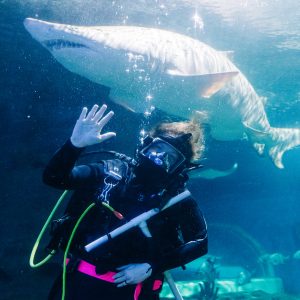 We dive for a variety of reasons. To commune with nature, to unwind, to explore. Our “pale blue dot,” as astrophysicist and author Carl Sagan pointed out, is just a “very small stage in a vast cosmic arena,” but perhaps by diving in we can learn to better appreciate that fragile ecosystem largely invisible to us as we commute between school, work and the grocery store in our busy daily lives.
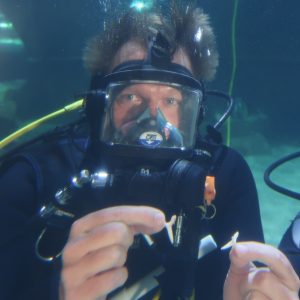 Scuba diving and Cleveland, Ohio . . . sort of go together like peanut butter and monkey wrenches, right? I challenge you to find one of those “101 Places to Dive Before You Die” books with a cover that isn’t turquoise, tropical and filled with colorful reef fish. And yet Cleveland has its own extensive dive community. Lake Erie, the shallowest of the Great Lakes, has hundreds of shipwrecks to explore and is serviced by several dive shops that teach classes, sell gear, and organize trips all over the world. Northeast Ohio is home to around 4.5 million people and an untold amount of scuba divers who love to explore the waters in their own backyard as well as adventure to distant places to see what there is to see in the 70% of our planet that is underwater.
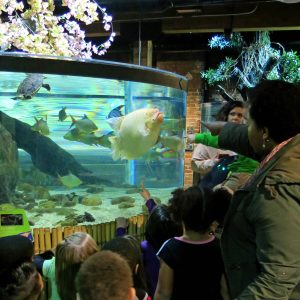 I was hired at Greater Cleveland Aquarium in November 2011 and with the exception of a COVID-related furlough, I have worked here as an employee ever since. I started off as a Guest Experience Associate—one of the welcoming team members stationed in our galleries to answer any and all inquiries about the animals or the facility. I then transferred to the Education Department as an Associate leading school tours. I was briefly an Education Assistant, which required that I book and schedule all tours, help develop and implement all materials for each grade and group that visits and collecting and processing payments. Eventually I took on the role of Office Assistant, and I have been doing the job ever since.
 There are so many more, but those are the ones that stand out in my memory. I must say that I look forward to countless more in my next 10 years!
 Exhibit design has everything to do with the Aquarium’s success, both rearing sea dragons and in terms of the destination’s unique appeal but retrofitting a historic brick powerhouse with an aquarium is not without its challenges, explains Senior Maintenance Technician and Exhibit Diver Mike Gorek, another employee who’s been on board since “before there was water.” “Finding opportunities in the limitations and figuring out how to create viable, one-of-a-kind habitats from scratch the way we have with the giant Pacific octopus arch or the Tropical Forest aviary is a fun and rewarding part of my job,” says Gorek. Guests who have not visited Greater Cleveland Aquarium since it opened will discover that its galleries have been rethemed and only a single exhibit—the red-bellied piranha habitat—has not been reimagined in some way.